The first of our talks on design and technology came from Craig Whittet encouraging the discussion of the demise of skilled, traditional manufacturing techniques and some of the implications of this.
One of the areas of manufacturing focused on was shoe manufacturing, an industry that illustrates this change in how goods are manufactured. Shoe manufacturing in Britain, particularly Northamptonshire, dates back to the 15th century. This area had a particularly large concentration of shoe makers as a result of the good supply of material due to a large cattle market as well as its central location for distribution. Shoemakers were highly skilled and usually had workshops in their homes where wives and children would help out to earn as much money as possible.
By the mid 19th century some shoemakers were described as manufacturers, employing a large number of shoemakers, supplying them with materials and selling the finished product on for them. Businessmen recognised that mechanisation meant more profit, this led to a mechanisation dispute between 1857 and 1859. A strike was called however many shoemakers didn’t object to mechanisation as long as it didn’t threaten their jobs. By 1861 the Turner Brothers were producing 100,000 pairs of shoes a week with the help of steam engines, this was the first shoe factory. In 1871 Charles Goodyear patented his welting machine, a machine used to secure the upper to the insole of a shoe. Shoes made using this method are still regarded as the highest quality.
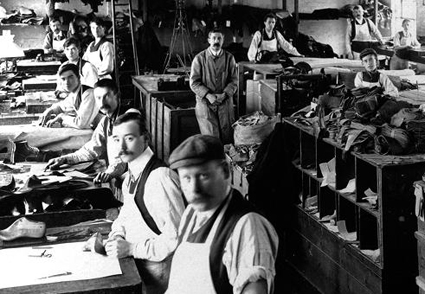
During the early 20th century the number of shoe factories continued to rise, apart from during the first and second world war where production mostly stopped other than for military purposes. After WW2, developments in the industry such as using glue instead of stitching meant that shoes became cheaper and of poorer quality. Export trade to Australia and Canada declined as the USA flooded the market with their cheaper product. Strikes among the British workers took place due to extended working hours and reduced salaries. The 50, 60 and 70s saw many changes in the manufacturing of shoes due to more, cheaper imports marking the decline of the footwear industry in Northamptonshire and Britain.
This template of the decline of a traditional manufacturing industry could be applied to many other industries throughout the world from clothing to food and drink. It shows how mechanisation reduced the number of positions for skilled workers but also reduced the quality of the product. This alongside competition from the now global market meant that the traditionally made, more expensive, higher quality product became almost completely overtaken compared to the newer, cheaper mass market products.
Some brands have survived by adapting to the market and appealing to the market of individuals looking for a high quality product that will last a lifetime. Endorsements and reputation have kept some brands afloat but there is no where near the level of traditional manufacturing than there once was. One reason for this is the lack of a young workforce in the industry. Apprenticeship jobs in this sector pay fairly poorly and require much higher levels of physical labour than standard office jobs, for example.
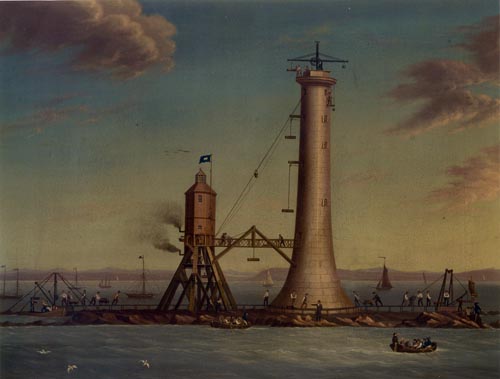
In many industries you get what you pay for in terms of quality. Shoes is one example of this however another interesting example that Craig presented was Bell Rock Lighthouse. Built in 1811 by the Stevenson Family, at a cost of £61,331.47 (millions in today’s money) 5 people died while building the project. This cost of life is obviously massive however the lives saved by the lighthouse would be in the thousands. The investment in the high quality structure means that the lighthouse is still standing although, similarly has become somewhat inept due to satellite navigation techniques.
In many cases, low cost means lower quality. However, perception of quality due to cost is a very interesting concept. For example, a bike frame built in Taiwan using the same techniques as one made it Britain may be of a much lower price due to advantages in lower labour costs and economies of scale. This product may well be perceived as being of inferior quality due to the lower cost and country of origin however is actually almost identical of an equivalent product made in Britain for 10x the price. This shows that it is not always as easy as endorsing smaller batch, local manufacturers as you don’t necessarily always get for what you pay for.
As many traditional crafts have almost been lost, modern industries have also actually created crafts. For example, injection moulding tooling must be hand polished by highly skilled and highly trained factory workers. These workers are some of the highest paid individuals in factories due to their experience which cannot be recreated by machines. I find this somewhat comforting in a world where machines are becoming increasingly intelligent, it proves that human jobs are a long way off becoming replaceable.
The demise of traditional manufacturing techniques is a really complex issue and opinions surrounding the topic can be approached from many different angles. You could say that it is a tragedy that the traditional crafts are being lost as the market dwindles and fewer and fewer young people are becoming trained in these skills. On the other hand, however, it could also be said that as industries change, opportunities for new skills are created too and we should all adapt to fit into this new world.
Personally, I hate the idea of traditional crafts being lost and in a such a throw-away society we would do well to appreciate the frugal attitudes that our close ancestors had. On the other hand, I am as guilty as anyone for purchasing cheap, poorly made goods more than I probably should. As fashions and trends change it’s easy to forget about those suffering from dyeing crafts in place for an easy and cheap solution.
Sources:
https://www.tredders.com/history
https://www.sargassoshoes.com/made-in-britain-a-brief-background-to-the-british-shoe-industry/
http://staffscc.net/shoes1/?p=126
 Jess Vinnels' Design Blog